The Habitat Unit of the CRAterre association focuses on the concept of housing in its broadest sense, i.e. as a human settlement. It takes a holistic and systemic approach to habitat, taking into account all its dimensions (social, environmental, economic, etc.). This approach considers not only how buildings are designed and constructed, but also how spaces are experienced and impact people’s quality of life.
More than a quarter of the world's population is housed in indecent conditions, despite the fact that housing is recognized as a fundamental right. Housing is a prerequisite for human dignity and personal fulfillment within any society: without decent housing, there can be no development.
The aim of the Habitat unit is to produce practical, usable knowledge by developing concrete projects and conducting field experiments. These initiatives are carried out in partnership with local communities and stakeholders, thereby promoting co-construction and the involvement of everyone in the process. Through this approach, CRAterre seeks to respond to contemporary housing challenges while respecting the cultural and environmental specificities of the territories concerned.
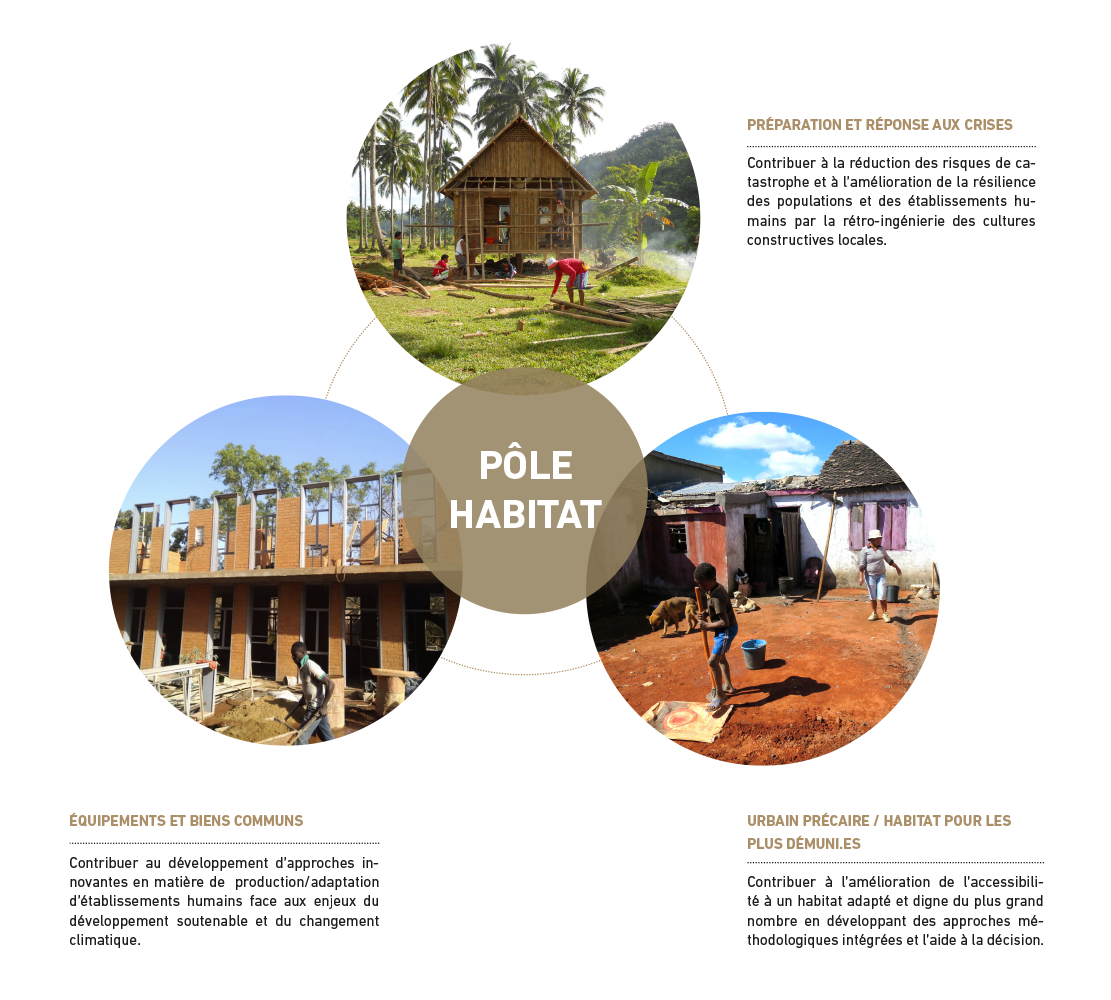
The Habitat Unit focuses its activities on three main areas
- 1
Urban slums / habitat for the most disadvantaged
- 2
Crisis preparedness and response
- 3
Facilities and common goods
Skills and services
The Habitat unit offers its expertise for the following services:
Methodology
The Habitat unit of the CRAterre association works to improve habitat conditions by studying and rethinking local building cultures with stakeholders, through action research and capacity building. The approach adopted is iterative, linking the field, research and teaching: research and training are informed by operational experience, and operations are improved by research findings.
Situated architecture
Our approach to habitat design aims for site-specific architecture. It is based on an assessment of the area, including a study of local building cultures, their current dynamics and the future directions they appear to be taking. This assessment provides a basis for leveraging existing strengths, responding to current needs, anticipating future challenges and thus designing the most relevant project possible in a given context. The aim is to offer high-quality living environments that are accessible to all and adapted to diverse environments and lifestyles.
Local building cultures
A Building Culture is the intangible dimension of a building or, more broadly, a human establishment built by people interacting with their environment in order to settle, work, move around, relax, etc. It includes elements related to the different phases of a building’s life cycle, from design to use, including construction, maintenance, modification or replacement, which cover sociological, economic, environmental and, of course, cultural aspects. The environmental conditions and history of each place are decisive in its evolution and potential cohabitation, and explain the great diversity of Local Building Cultures around the world. Local Building Cultures are particularly interesting in the context of (re)construction projects, as they are based on:
- existing knowledge and expertise mastered locally (local economy, reproducibility, maintenance),
- adapting housing to households’ means, needs and lifestyles,
- rational use of locally available resources in response to environmental and climatic constraints.