The National School of Architecture and Urban Planning (ENAU) is hosting the first edition of the international conference "26'تراب – Turâb’26: experiences of the de-materiality of earthen construction", co-organized by:
- The Heritage, Architecture and Ambiance (LarPAA) & Sustainable Cities and Built Environment (VDEC) research laboratories, National School of Architecture and Urban Planning (ENAU) – Carthage University (UCAR)
- The International Center for Earthen Construction (CRAterre), Grenoble National School of Architecture (ENSAG) – Grenoble Alpes University (UGA)
- The Geotechnical Engineering and Geo-Risks Laboratory (LIGG), National Engineers School of Tunis (ENIT) – Tunis El Manar University (UTM)

ABSTRACT :
Every handful of earth holds a story of "de-materiality," where the sensory philosophy of earth coexists with innovations and new technologies that push its technical limits in a desire to destigmatize it. Although durable and ecological, earth as a material faces cultural resistance tied to an image of precariousness, a perception fostered by modernity. Thus, in the context of alarming climate change, reinventing earthen construction has become urgent, if not necessary.
This conference approaches research on earthen construction at the crossroads of poetics, engineering, and innovation. By highlighting earth architecture in Tunisia and around the world, it offers a transdisciplinary and resilient perspective on a universal material, putting its inextricably linked material and immaterial dimensions in tension.
CONFERENCE’S ARGUMENT :
In the Bachelardian approach to the poetics of the world around us and his conception of the role of the four elements of nature in structuring our imagination, the element "Earth" has never been elementary. Indeed, by summoning a dialectic of hard and soft, this approach has so intensely shaped reveries of matter that it would be difficult to distinguish its materiality from its immateriality, thereby inscribing it within a holistic framework. Extrapolating this imaginary stratification of earth to its modeling and work, this "de-materialized" vision of earth as a matter that questions the relationship between the imaginary and the rational, between creation and science, is at the heart of current debates on contemporary earthen construction worldwide.
Erecting buildings with the very material of their grounding and rootedness in the soil speaks to both the creativity and the resilience of the act of building with earth today. Indeed, reinventing earth architectures and cities as an ecological commitment in a context of environmental crisis is no longer in question. As a building raw material that is at once free, durable, and culturally embedded, earth is economically, ecologically, poetically, and technically appealing. However, it also instills fear, as it conveys an image of precariousness and constructive fragility that fosters a form of cultural and psychological resistance to its adoption. How can we value earthen heritage? What are the mechanisms for transforming and changing such a stigmatizing sociocultural perception of earth architectures?
Facing the frantic technological advances of the Construction 4.0 industry and as the most widespread building material worldwide, earth is compelled to reinvent itself to meet current constructive requirements for resistance, comfort, aesthetics, and durability. How can we reinvent earthen construction methods and techniques? What is the role of new technologies in the sensitive constructive processes of local cultures in earthen construction? To what limits can we push technology in earthen construction so that innovations are in harmony with the sensitive and poetic philosophy of the material? What are the key players for an earthen construction ecosystem that aligns with new technologies?
By approaching research on earthen construction through practice and honoring earth architecture in Tunisia and around the world—and in doing so, examining still-unexplored questions related to its knowledge, recognition, and conservation—this conference offers a transdisciplinary and resilient perspective on a universal material that has a future.
Thematic Axes:
AXIS 1. On the Poetics of earth
This thematic axis of the conference opens the door to the rediscovery of a material that, beyond its physical properties, is capable of generating ambiences and emotions, paving the way for the uniqueness of experiences that explore the story told by the earth.
The poetics of earth lie in a woven link with the environment and the human being. Consequently, earth holds a memorial potential, a carrier of identity and a true cultural marker through time. This specificity is all the more magnified by the act of building spaces with the very material of their grounding in the soil. The result is an architecture whose purpose is to blur the tangible boundaries of the building and to make the reading of a volume superfluous in a poetics of evanescence, erasing the border between the built and its environment.
The poetics of earth are also an invitation to explore a sensory experience that considers the feel of the material under the hand, its temperature, its smell, its shaping, and its reshaping. Thus, the user's perception of their space is strongly influenced by the sensory qualities of the "earth" material. By its shades and textures alone, it is capable of visually varying the warmth of a space. Much more than a question of climatic comfort, the ambiences generated by earth become design elements that subtly intersect with the narratives, beliefs, and social structures linked to vernacular earthen architectures. Ultimately, the link between earth, collective memory, and the identity that shapes inhabited spaces is brought to the fore.
At the crossroads of the senses and the imaginal, this axis questions earth as a dematerialized spatial experience through history, cultures, and societies. The atmospheres, colors, textures, smell, sounds, and sensitivities related to this material, its form, and its work are explored. Local constructive cultures, as well as the oral knowledge and practical know-how in earthen construction, are revealed through sensitive approaches that call for considering the creative imagination of the material and the architectural and urban ambiences it generates.
AXIS 2. On the Engineering of earth
By bridling techniques and marrying knowledge, humankind has erected with earth the most striking monuments in the history of the material and spiritual development of human settlements, thus proving the resistance, solidity, and universality of this material.
Facing the paradigmatic crisis that earthen construction experienced with the advent of the industrial era, attempts have been made to rationalize and modernize the learned and popular know-how of earth. Thus, since the oil crisis of the 1970s and the environmental challenges it has brought, construction policies worldwide have had no choice but to attempt a creative and operational synthesis between traditional and modern techniques for building with earth. By analyzing this endogenous knowledge and optimizing it to adapt to current constructive challenges, the contemporary formal, structural, and energetic approach to earthen construction blends with modern processes that tend to increase the resistance of earth. If stabilizing it solves the structural challenge, what about its aesthetics?
The modernization of earthen construction methods has solved the structural aspect but has raised an aesthetic problem. By prefabricating compressed earth blocks or rammed earth wall panels and stabilizing them, we move closer to a formal, orthogonal, and smooth constructive aesthetic that resembles concrete elements, rather than the sensual aesthetic emanating from the ancestral modeling of earth. This downside is even more unsettling if we consider the near absence of a regulatory framework for earthen constructions worldwide. Yet, these buildings, erected for centuries, are still visible and present as a symbol of resistance that defies any absence or presence of legislation.
In this axis, the evolution of earthen construction techniques is traced, alternating between an intuitive and a reflective understanding of the structural, geotechnical, and energetic properties of earth. Educational approaches to this material are examined, considered essential, and leading to a thoughtful and conscious hybridization of technical knowledge and endogenous know-how for an experience of the materiality of earth, its technical possibilities, and its constructive limits in the face of the challenge of durability.
AXIS 3. On the Innovation of earth
Research and development pave the way for innovation in earthen construction. This axis explores the "earth" material from its materiality to its immateriality. Indeed, innovation in earthen construction is not limited to improving its physical properties; it now extends to the digital realm.
With a focus on building energy optimization, earth becomes an "augmented" material through the Internet of Things (IoT), piloting its avatar, its digital twin, which provides a real-time overview of its energy behavior in the face of heat, cold, humidity, air, light, or even sounds and smells. The ambiences generated by earth are controlled, shifting from a natural state to an artificial one. A true vector of technology, earth forms are no longer sculpted but become parametric, obeying the rules of generative design and allowing for the creation of complex structures optimized for resistance and energy performance. Surveying sculpted and irregular earth forms has also been revolutionized recently. The Scan-to-BIM processes offer a solution for this, integrating management and maintenance operations to be performed on earthen constructions into a Heritage Building Information Modeling (HBIM) methodology, exploring the semantic ontologies for the restitution of these architectures, which are as complex as they are simple.
Gaining on time, cost, and execution effort, 3D printing of earth structures and forms is one of the most promising advances. By using specific earth and additive mixtures, walls, domes, and even entire buildings can be erected layer by layer, without formwork or a large workforce. Immersive environments, in turn, transform the perceptual experience of earth architectures and allow for living the earth by projecting into an augmented, virtual, or mixed reality. These environments serve users as much as builders and artisans, offering them the possibility of testing new constructive systems in earth to ensure their proper implementation.
Ultimately, this axis explores how cutting-edge technologies transform the architectural and urban experience, making earth a medium for innovation and durability. Thus, through the integration of digital tools, earth contributes to more adaptive, interactive, and connected environments. The paths of innovative research in this field are explored, as well as their developments at different scales via advanced technologies.
FORMAT:
The conference will be held in person.
DATES :
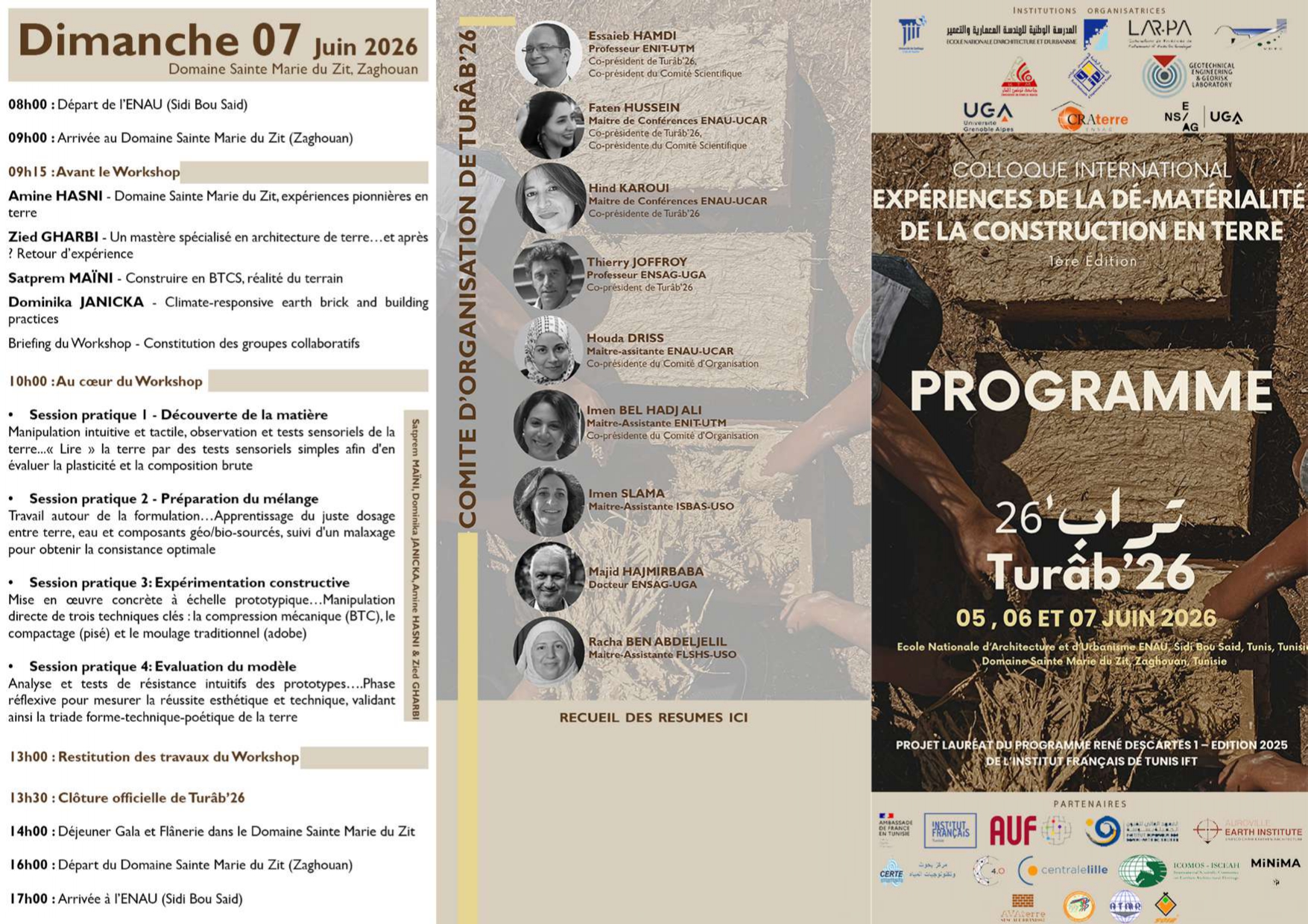
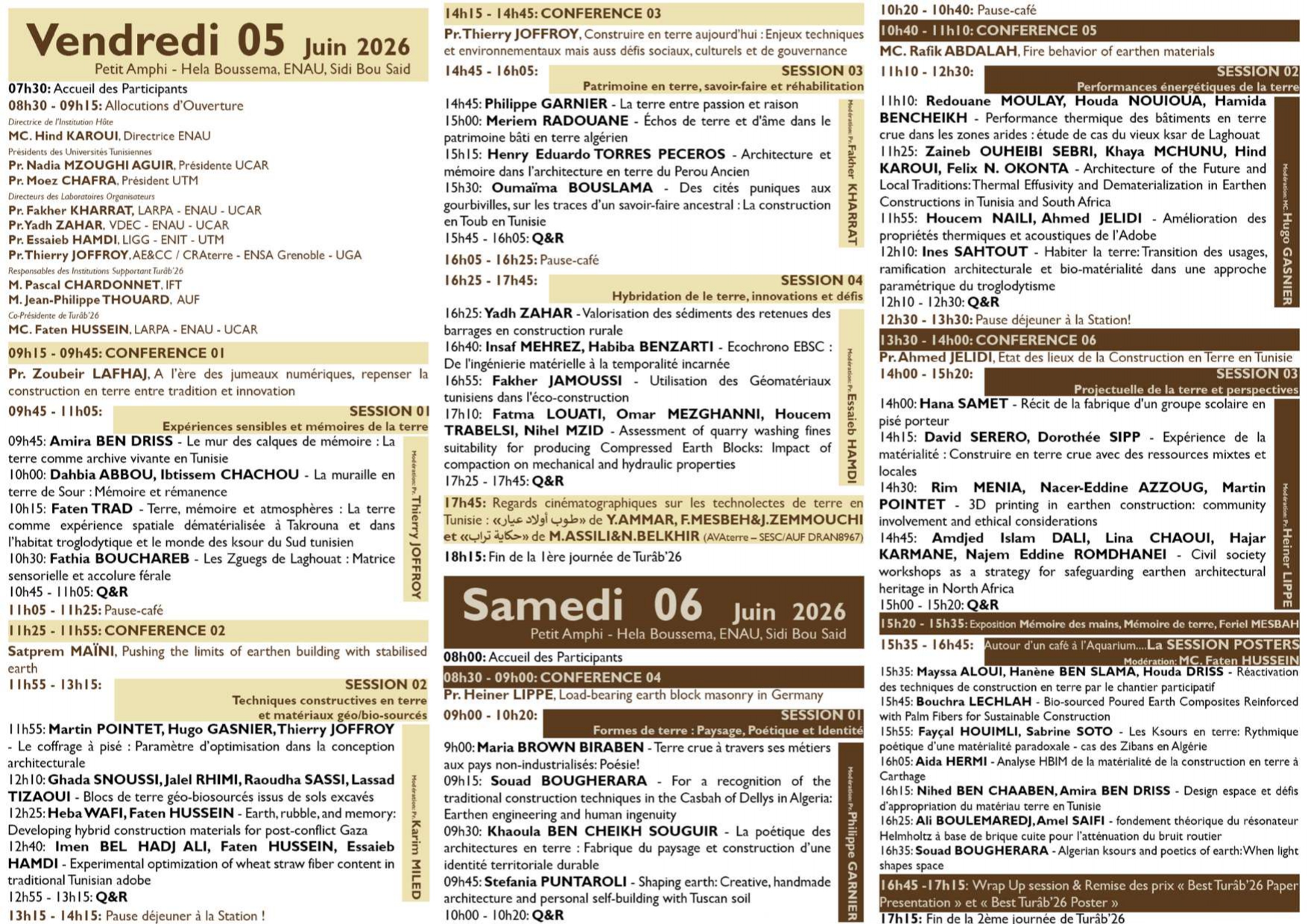
June 05, 06 and 07, 2026
VENUE :
June 05 & 06, 2026: National School of Architecture and Urban Planning ENAU, Sidi Bou Said,Tunisia
June 07, 2026 : Sainte Marie du Zit Property, Zaghouan, Tunisia
PROGRAMME :
- Lectures: https://heyzine.com/flip-book/8aba596a63.html#page/1
- Workshop: https://heyzine.com/flip-book/95ae72209f.html
- Artistic activities & exhibitions: https://heyzine.com/flip-book/53cc7aed09.html#page/1
INFO & CONTACT :
faten.hussein@enau.ucar.tn