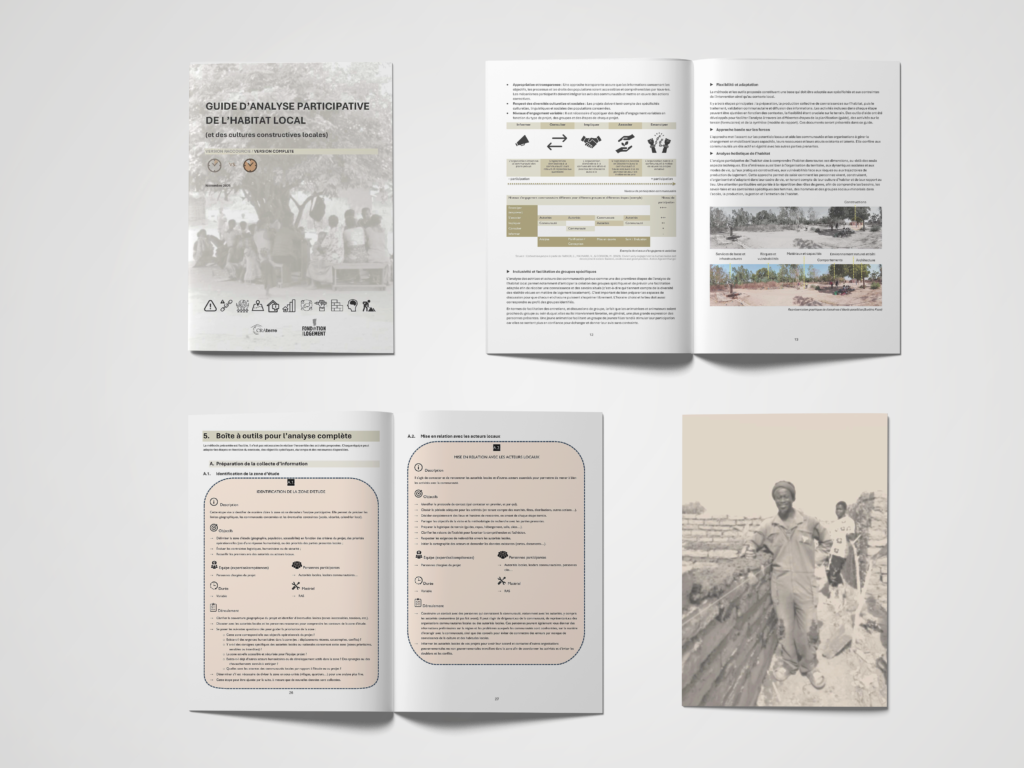
Understanding the context is an essential step in any housing project. The participatory local housing analysis methodology proposed in these guides aims to document, together with communities, housing production and management methods. It can be used both at the start of a project and throughout its implementation, in order to update field information and strengthen links with local partners.
This analysis then serves as the basis for designing shelter and housing projects built with communities, adapted to the climate and diverse lifestyles, based on existing practices and locally available resources, and incorporating an inclusive approach that is sensitive to social, cultural, and economic inequalities.
The guide Assessing Local Building Cultures for Resilience and Development (Caïmi & Moles, 2015), developed in 2010 and tested in several countries, is the primary reference for this approach. A simplified version, produced in 2019, has facilitated its dissemination in many contexts. In 2025, a complete revision of the method and its tools was carried out, based on more than a decade of feedback, in order to improve practices, processes, and results.
The revised guides are accompanied by forms for interviews, surveys, and focus groups, as well as a report template that facilitates the structured presentation of the information collected. They also incorporate a cross-cutting gender perspective, making it possible to better take into account inequalities related to gender roles and to highlight the diverse experiences of women, men, and minority or underrepresented groups in housing and construction contexts.
Download the complete guide Download the short guide